The removal of the Breton rocks
The Canterbury TalesThe removal of the Breton rocks is the decisive magical episode in which a young scholar attempts to make the rocks along the Breton shore seem to disappear. It answers Aurelius’s desperate need to escape the promise made by Dorigen, who has said that she will yield to him if the dangerous rocks vanish. The episode therefore places human desire against the apparent permanence of nature: a landscape that has seemed fixed becomes, for a limited time, visually absent, and the illusion threatens to turn a rash promise into an enforceable reality.
Causes and Background
The episode begins in the pressure created by Dorigen’s impossible promise to Aurelius. Aurelius’s love has become so painful that he contemplates either dying from his distress or ending his life with a sword. His suffering is not relieved by ordinary consolation, because the obstacle before him is presented as physical and absolute: the Breton rocks stand between his desire and the condition Dorigen has named.
Aurelius’s brother has been privately grieving with him, but a chance recollection changes the direction of the crisis. Aurelius remembers that, while studying at Orléans in France, he may have encountered an old friend who knows the lunar mansions. This knowledge is associated with the learned arts through which celestial timing and magical appearance can be manipulated. The recollection converts despair into a plan: instead of accepting the rocks as immovable facts, Aurelius will seek someone capable of making them appear to be gone.
The Search for a Magician
As Aurelius and his brother approach Orléans, they meet a young strolling scholar only a short distance from the city. The encounter joins the physical journey to the intellectual and magical solution that Aurelius has been seeking. The scholar is not introduced as a distant supernatural being but as a learned figure encountered on the road, which makes the extraordinary bargain emerge from an apparently ordinary meeting.
The scholar pities Aurelius deeply. His response is not merely to listen but to work day and night on a plan, searching for the propitious time at which the operation can be completed. The episode thus gives magical power a procedural character: the effect depends on study, calculation, timing, and sustained labor rather than on an instantaneous marvel. The language of lunar mansions places the intervention at the border between academic learning and the forbidden or suspect practices condemned as heathen illusion.
The Bargain and the Illusion
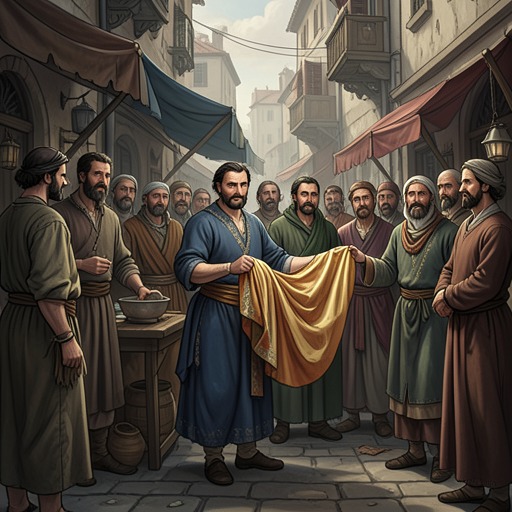
After they have supped, Aurelius and the scholar negotiate the scholar’s compensation. Aurelius agrees to pay him for dispelling all the rocks from the Breton shore. The meal and the subsequent negotiation make the episode resemble a commercial contract as much as an enchantment. Love’s crisis is translated into a fee, a technical service, and a promised result; the emotional stakes remain immense, but the action proceeds through calculation and payment.
The scholar’s work is undertaken through magic and lasts for a week or more. During that period, it seems to everyone looking upon the shore that the rocks have left it. The crucial word is appearance: the rocks are not described as physically destroyed, but as absent to sight. The magician’s success therefore rests on an illusion that temporarily alters perception rather than on a permanent alteration of the Breton landscape.
That distinction gives the event its moral and structural force. Aurelius receives what he needs in practical terms, because the condition of Dorigen’s promise appears to have been met. Yet the same success exposes the danger of treating a visual effect as a solid foundation for human obligation. Nature has not necessarily changed, but the social consequences of believing that nature has changed may be entirely real.
Consequences and Aftermath
The removal of the rocks is designed to bring Aurelius out of the bitter pain caused by his love. Its immediate consequence is therefore a reversal in his prospects: the impossible condition that had blocked him now appears to have been overcome. The value at stake shifts from hopelessness toward apparent fulfillment, but the shift is unstable because it depends on a magical display whose duration is limited.
The episode also prepares the moral conflict that follows. If the rocks can be made to disappear for only a week or more, then the event places pressure on the difference between literal truth and practical appearance. Dorigen’s promise is confronted not by a natural miracle but by an engineered illusion, and Aurelius must face what such an accomplishment permits him to claim. The magician’s success does not settle the question of love; it sharpens the question of whether a promise obtained under impossible conditions should bind the person who made it.
Narrative Significance
The event mediates between two opposed worlds. On one side is the stubborn materiality of the shore, where rocks seem to embody permanence and danger; on the other is the unstable human realm of desire, speech, and reputation, where a desperate promise can create obligations more powerful than physical barriers. Magic becomes the mediating device between them. It neither simply confirms nature nor wholly abolishes it: instead, it makes nature uncertain by changing what observers can see.
The episode also reveals the tale’s characteristic movement from private feeling to public consequence. Aurelius’s lovesickness begins as an inward torment shared with his brother, then becomes a remembered possibility, a journey, a scholarly consultation, a negotiated payment, and finally a transformation visible to everyone who looks toward the shore. The rocks’ apparent disappearance is thus both a technical achievement and a narrative trap. It offers Aurelius relief while forcing Dorigen, Aurelius, and Arveragus to confront whether appearances can discharge a promise and whether honor can survive an act founded on illusion.